
Part III · Christ’s Work·Week 18 of 30
Reconciliation
Before you gather
- Read Day 18, Reconciliation, in The Visual Gospel. Do not reteach the essay.
- Read Ephesians 2:13–18 in your Bible. The excerpt below is only a backup.
- Your people should already have answered the day’s reflection questions. Do not ask those again.
1 · Icebreaker · 7 min
Open the room
What is a small wall people build without noticing — a closed door, a group text, a seat saved, a silence?
Leader. Ordinary walls. Do not ask them to retell a resolved conflict and how it felt. That is the journal question. Say that passing is allowed, especially the first few weeks.
2 · The word · 8 min
See it, then say it
If you need the words
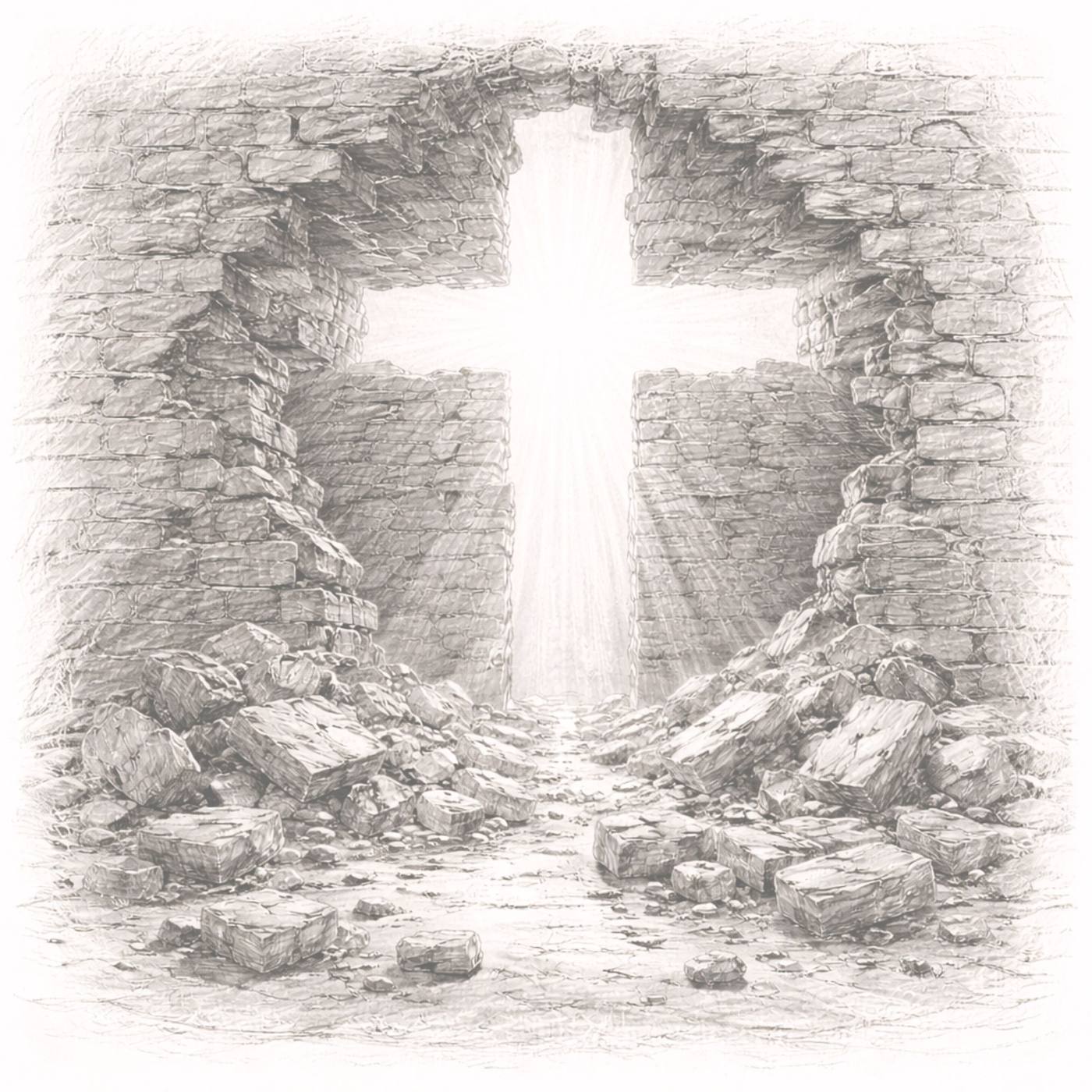
Say: Sin did not make God distant in a vague way. It made enemies. Reconciliation is God ending the war by the blood of the cross and opening a way through the wall. We do not climb it. He breaches it.
- Definition, from the book
- Reconciliation is God ending the war and separation our sin created by the blood of His Son, Jesus Christ, and granting us lasting peace with Himself.
- In the original language
- Greek katallagē — a change from enmity to friendship. Also eirēnē — peace.
- Memory verse · Colossians 1:19–20
- For in him all the fullness of God was pleased to dwell, and through him to reconcile to himself all things, whether on earth or in heaven, making peace by the blood of his cross.
Together, open the flashcard for Reconciliation. Say the word, the definition, and the verse once. Then put the phone away.
3 · Open the Bible · 15 min
Ephesians 2:13–18
Romans 5:10 was the devotion’s reading. Ephesians 2 is the wall in the drawing: hostility between people, and between us and God, broken by one cross.
But now in Christ Jesus you who once were far off have been brought near by the blood of Christ. For he himself is our peace, who has made us both one and has broken down in his flesh the dividing wall of hostility by abolishing the law of commandments expressed in ordinances, that he might create in himself one new man in place of the two, so making peace, and might reconcile us both to God in one body through the cross, thereby killing the hostility. And he came and preached peace to you who were far off and peace to those who were near.
Have two readers if you can. Bibles open. The excerpt is only here so a forgotten Bible does not stop the night.
From the passage
1.What did the wall divide, and what, specifically, tore it down?Core
Leader. Jew and Gentile, and both from God. The wall comes down in His flesh, by the cross, not by the groups deciding to be mature.
2.Paul says Christ “himself is our peace.” How is that different from Christ giving us some advice about peace?
Leader. Peace is a Person we are brought into, not a technique we master. Nearness is “by the blood.”
4 · Around the room · 20 min
A conversation this chapter did not assign
3.Colossians 1:21–22, if you read it, remembers that we were hostile in mind. What does reconciled peace with God make possible that a truce would not?Core
Leader. A truce pauses the shooting. Reconciliation changes the relationship: holy, without blemish, welcomed. God is not barely tolerating His people.
4.The same cross reconciles us to God and to one another. Where is our church still living as if a wall Christ killed were still load-bearing?
Leader. Race, class, age, politics, old offenses. Be concrete and local. Do not let this become a speech. Ask what obedience would look like this month.
5.2 Corinthians 5:18–20: reconciled people are given the message of reconciliation. If peace has already been made from God’s side, what are we actually asking a friend to do?
Leader. Not to appease an angry deity with gifts. To receive a peace already accomplished, and to come home. Ambassadors announce terms. They do not invent them.
5 · Say it · 5 min
In one sentence
Reconciliation means God ended the war our sin started, through the blood of the cross, and brought us near.
Ask for two volunteers, not the whole circle. They may look at the sentence, then try it without looking. Clumsy and true is the goal.
6 · Pray · 8 min
Leave silence between these
- Thank Christ, who is our peace.
- Confess a wall you have maintained.
- Pray for one relationship, and for one person still far off.
Before you stumble
“All things” in Colossians 1:20 is not universalism. Paul has just said reconciliation comes by the cross, and the next verses call people to continue in the faith. Enemies are made friends through Christ, not apart from Him. If the room wants the horizontal peace (people with people) without the vertical (people with God), Ephesians will not allow it. The cross does both, in that order.
With students
Ask which hallway at their school has an invisible wall. Then ask what it would mean that Jesus, not a program, is the one who can actually kill hostility. Keep it from becoming a rant about other students.
If you still have time
Romans 5:1 and 5:10–11, only if you need the word “enemies” said plainly. Do not camp there. They reflected on 5:10 already.